

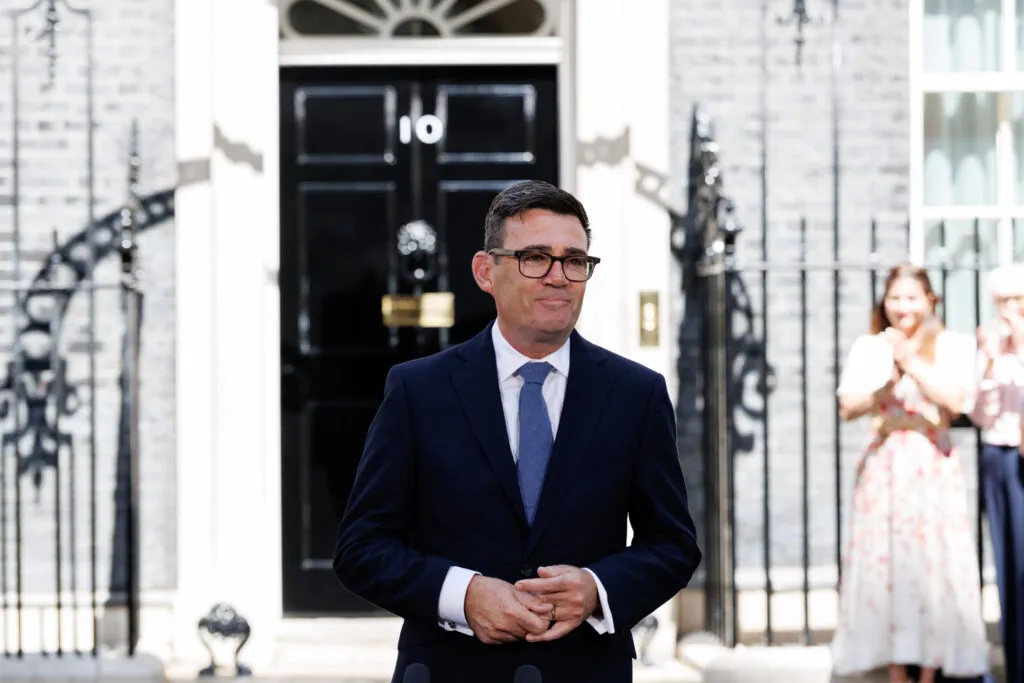
Prime minister Andy Burnham has unveiled his devolution strategy, handing mayors across the country more decision-making powers as well as a share of income tax for the first time.
As part of the government’s plans to launch “biggest transfer of power from Westminster in a generation”, mayors will begin retaining a greater share of locally generated revenues, starting with business rates, from next spring.
The newly appointed prime minister also said areas without mayors will still see their respective strategic authorities keep some cash from business rates collected in their areas.
Under these plans, local leaders will be given powers to build more homes where they’re needed and unlock stalled development sites with stronger planning and regeneration powers and more devolved funding.
“I said we’d take power out of Westminster and carry it into every postcode in the country,” Burnham said. “Today, we make good on that promise.
“Under our plans, more of the taxes raised in a community will stay in that community. Soon, every local leader will have the power and resources to improve public transport, build homes and create jobs.
“I know what it’s like to be ignored by politicians in Westminster. I’m not going to make that same mistake now I’m PM. The whole of government will now pull together behind the people and places that desperately need our support.”
Other powers will enable local leaders to bring rail and bus services under greater local control, give them more control over large local transport schemes, and enable them to back local industries and businesses in a bid to attract investment and create new jobs.
This follows Burnham’s 20% business rates cut for nearly 32,000 pubs, clubs and live music venues, announced last week and set to come into force next April.
Housing secretary Angela Rayner added: “This is the first step in our plan to rewire this country and build a better future, where power is no longer hoarded in Westminster but is put back in the hands of local people, where it belongs.
“Our devolution revolution is about bringing an end to the begging-bowl culture of the past, and instead making sure our local leaders have the tools they need to drive the change that communities have been crying out for.”
Further details on these devolution plans, as well as income tax retention, will be set out in a roadmap at the Autumn Budget.
Vanessa Hale, chief executive of Real Estate:UK, said the announcement marked another “positive step in incentivising mayors and local leaders to take a more strategic role in growing their economies, creating jobs, and improving their high streets and town centres”.
“Mayors and strategic authorities have an increasingly important role to play in not only convening economic growth and development, but in commissioning it now too,” she added.
“However, in order to maximise these potential benefits for the economy overall, we still need to see comprehensive reform of business rates along with the continuation of a welcoming investment climate.”
Paul Rickard, chief executive of Pocket Living, said: “Devolving more powers to mayors to take a more muscular approach to housing delivery and transforming their communities is certainly to be welcome.
“There is also a golden opportunity to combine skills and training provision, housing supply, and the needs of business into one integrated approach to grow their local economies. As part of this, we would suggest that mayors not only have a role to play in commissioning new homes, but in aligning them with the needs of key industrial sectors.”
Please visit:
Our Sponsor